Independent information
This is an independent information service. Cost estimates and savings figures are compiled from Energy Saving Trust publications and government sources. Actual costs and savings depend on your property's specific characteristics. Always ensure adequate ventilation is maintained in your loft space.
Types of Loft Insulation
The right type depends on your loft's accessibility, whether you use it for storage, and your budget. Here are the main options available.
Most common
Blanket / roll insulation
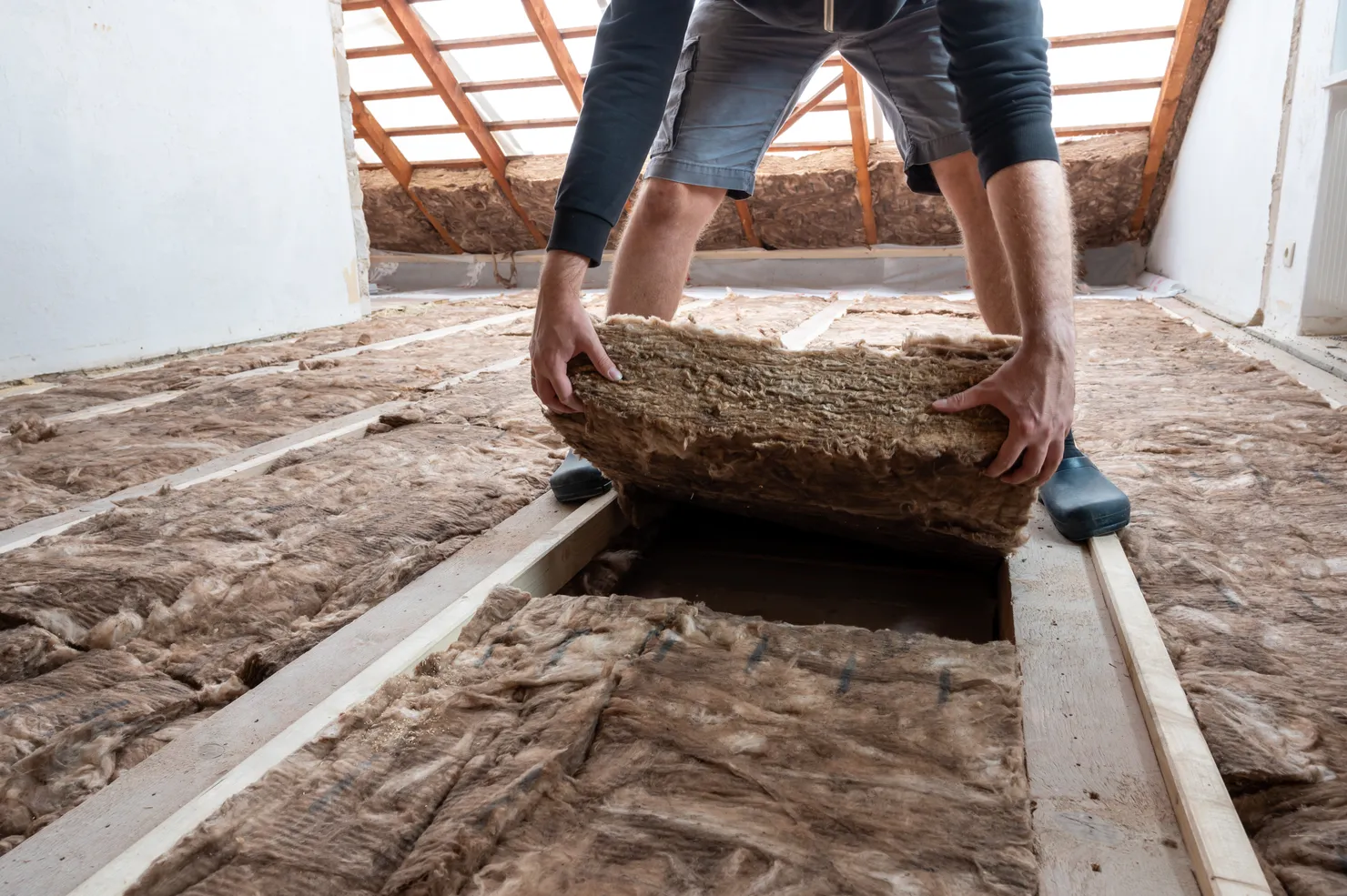
Mineral wool rolls (such as glass wool or rock wool) are the most common and cost-effective option. Rolls are laid between the joists first, then a second layer is laid across the top to reach the recommended 270mm depth.
Best for: Accessible lofts with regular joist spacing. Suitable for DIY installation.
For awkward spaces
Loose fill insulation
Loose mineral wool, cellulose fibre, or cork granules are blown or poured between the joists. This method is particularly useful for lofts with irregular joist spacing or hard-to-reach areas where rolls cannot easily be laid.
Best for: Awkward spaces, topping up existing insulation, and areas inaccessible for roll insulation. Usually professionally installed.
Caveat applies
Spray foam insulation
Sprayed directly onto the underside of the roof. Effective but more expensive, and potentially problematic — some mortgage lenders have concerns about spray foam, and it can affect roof ventilation and future resaleability.
Best for: Loft conversions or where the roof space needs to be habitable. Seek independent advice before choosing this option.
Recommended Depth & Costs
Standard
The 270mm standard
According to current building regulations, the recommended depth for mineral wool loft insulation is 270mm. This is typically achieved by laying a first layer between the joists (usually 100mm) and a second layer across the top of the joists to reach the full depth.
Many older homes have only 25mm, 50mm, or 100mm of insulation — sometimes none at all. Topping up to 270mm is one of the simplest and most effective improvements you can make.
Note: Going beyond 270mm provides diminishing returns. According to the Energy Saving Trust, the first 100mm does most of the work, and 270mm captures the vast majority of the benefit.
Costs
Typical costs
- Professional install: £300–£700 according to the Energy Saving Trust
- DIY materials: £5–£10 per square metre for mineral wool rolls
- Grant-funded: Free for eligible households, route depends on nation
- Payback period: According to EST, around 2 years if paying privately
- EPC impact: Can raise your rating by 1–2 bands
DIY vs Professional Installation
DIY route
DIY is possible if...
- Your loft is accessible with a proper loft hatch
- There is enough headroom to work safely
- The loft has boarding or joists you can move across
- There are no damp or condensation issues
- You are comfortable working in a dusty, confined space
Safety: Wear a dust mask (FFP2 or better), gloves, long sleeves, and goggles. Mineral wool fibres irritate skin and lungs. Step only on joists, never between them — the ceiling below will not support your weight.
Pro route
Get a professional if...
- Your loft has limited access or low headroom
- There is existing wiring that needs careful handling
- You have a flat roof or room-in-roof construction
- You want to claim grant funding (every scheme requires a certified installer)
- There are signs of damp, condensation, or pest activity
- You have a water tank in the loft (needs insulating separately)
Important considerations
Ventilation
Adequate ventilation in the loft space is essential. Insulation keeps heat in the rooms below, which means the loft itself becomes colder. Without proper ventilation, moisture can condense on cold surfaces and cause damp and rot. Do not block eaves ventilation gaps or soffit vents when laying insulation.
Pipes & water tanks
An insulated loft floor means your loft will be colder in winter. Any water tanks or pipes in the loft need their own insulation to prevent freezing. Insulate above and around water tanks but not underneath them — they need some warmth from the rooms below.
Loft storage
If you use your loft for storage, you will need raised boarding above the insulation to avoid compressing it. Compressed insulation is significantly less effective. Loft legs or raised platforms allow you to maintain the full 270mm depth whilst keeping a usable storage area above.
Flat roofs
Flat roof insulation is a different process and usually requires professional installation. It can be added above or below the existing roof structure. This is not a DIY job — consult a specialist.
Which loft insulation funding route applies to you
Loft insulation remains the most commonly funded measure, but GBIS closed in March 2026. The live routes are Warm Homes: Local Grant in England, Warmer Homes Scotland, Nest in Wales, and Affordable Warmth or NISEP in Northern Ireland.
Key eligibility factors:
- England only — not Wales, Scotland or Northern Ireland
- EPC band D, E, F or G
- Household income of £36,000 a year or less, a qualifying means-tested benefit, or a low-income postcode
- Owner-occupiers and private tenants with the landlord's consent (not social housing) — owner-occupiers and tenants are not expected to contribute anything, and a private landlord gets one home fully funded and pays half the cost on each additional home
- Separate caps for energy performance and low carbon heating, funding a whole-home package of measures — the caps are averaged across a council's whole project, not a sum a household can claim
- Apply on GOV.UK first and you are passed to your council, which decides — some councils have paused while their funding lasts. Greater Manchester and the West Midlands are funded through their combined authorities instead: West Midlands households still apply through the same GOV.UK service, while Greater Manchester households are sent to the GMCA retrofit portal
Check your property against the live MHCLG EPC register to see your current band and the schemes you may qualify for — free, in under a minute.
Check your propertyGet a free loft insulation quote
Whether you are checking which grant route covers your household or want a competitive private quote, Energy Pages can connect you with certified installers in your area.
No obligation. Energy Pages connects you with certified installers in your area.
How to get loft insulation installed
Check eligibility
Check which route covers your address. If you receive qualifying benefits you may get loft insulation funded — through your council in England, or the devolved scheme where you live.
Loft assessment
An installer checks your loft for accessibility, existing insulation depth, ventilation, and any issues that need addressing first.
Installation
Mineral wool is laid between and across the joists to reach 270mm. Typically completed in 2–3 hours for a standard loft.
Start saving
You should notice the difference immediately. Your EPC can be updated to reflect the improvement in your energy rating.
Related guides
Closed scheme
GBIS (closed)
Funded most loft insulation until March 2026. Kept as a record, with the live routes mapped.
Read guide →EPC guide
Improve your EPC rating
Loft insulation is one of the fastest ways to improve your EPC. See all improvements ranked by impact.
Read guide →Heat pumps
Heat pump guide
Insulate first, then add a heat pump for maximum efficiency. £7,500 grant available.
Read guide →Ready to insulate your loft?
Loft insulation is quick, effective, and may be fully funded for eligible households — which route applies depends on where you live. Check your eligibility and get connected with certified installers.