Last reviewed: . Cost and savings figures are compiled from Energy Saving Trust publications; guarantee information is from the Cavity Insulation Guarantee Agency. Scheme rules and funding availability change — confirm the current position before you apply, and always get a professional survey before proceeding.
What is cavity wall insulation?
According to the Energy Saving Trust, around a third of the heat in an uninsulated home escapes through the walls — more than through the roof. Cavity wall insulation fills the gap between the inner and outer layers of the external walls, and on a suitable property it is among the cheapest ways to stop that loss.
How cavity walls work
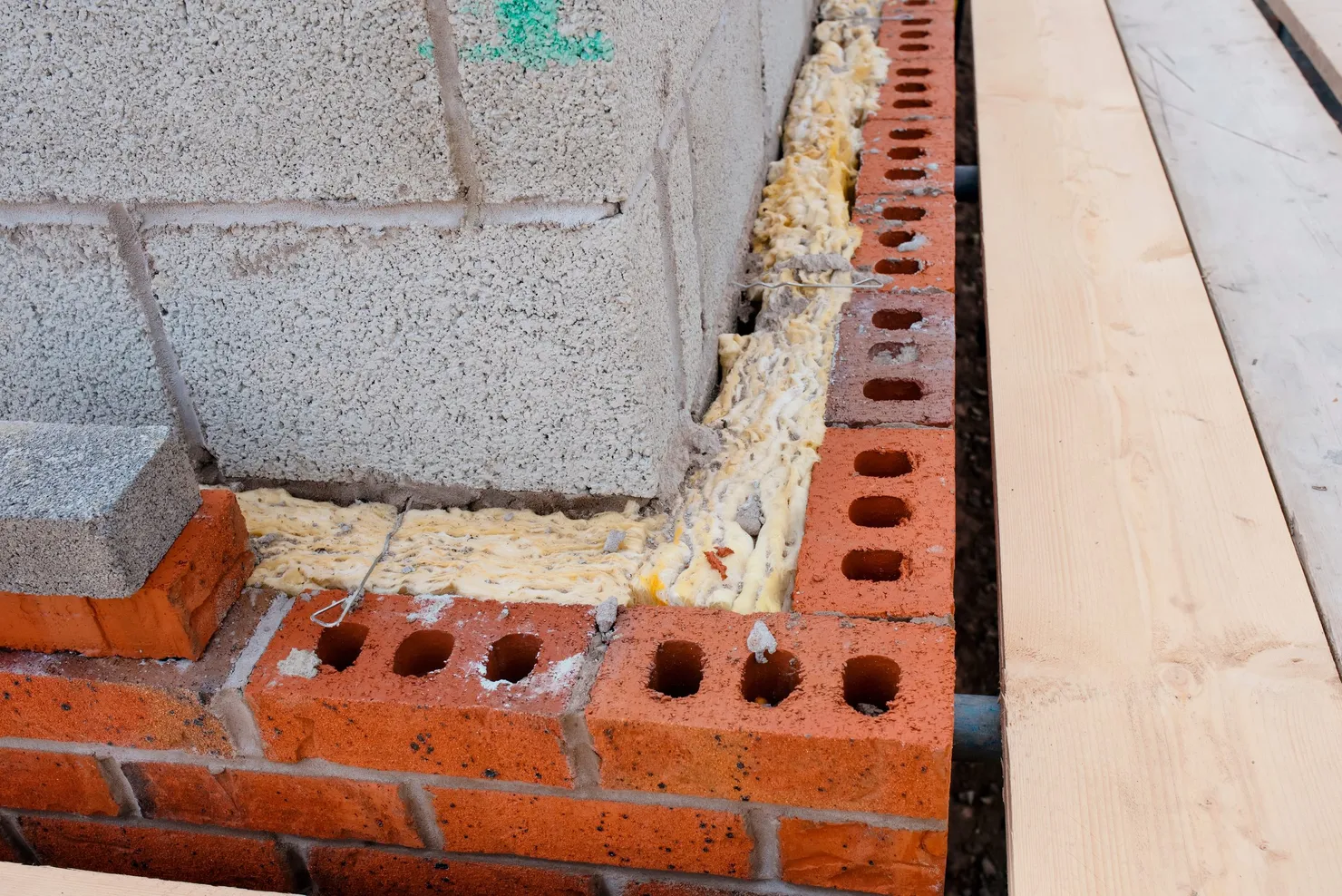
Most homes built from the 1920s onwards have external walls made of two layers of brick or block with a gap between them. The cavity was left empty deliberately: it stops moisture crossing from the wet outer leaf to the dry inner one, which is exactly the failure that solid walls suffer from.
The gap also lets warm air circulate and escape, so it solves one problem and creates another. Modern cavity fill is designed to close the thermal gap without closing the moisture defence — the material is water-repellent, so it resists moisture crossing while still stopping the airflow. That is the whole engineering question on this measure, and it is why an unsuitable wall gets refused rather than filled.
Three ways to tell what you have
- Build date. Homes built between the 1920s and 1990s usually have cavity walls; anything built after 1990 almost certainly does.
- Brick pattern. A uniform pattern of long bricks laid end to end indicates a cavity wall. A repeating pattern that includes shorter brick ends indicates solid brick, where bricks are turned through the wall to tie it together.
- Wall thickness. Measure at a window reveal or the front door. Over about 260mm suggests a cavity; around 220mm suggests solid.
Your EPC report states the wall type as assessed, and a surveyor settles it with a borescope — a small camera through a drilled hole, which also shows whether the cavity is clear and how wide it is.
Key facts
At a glance
- Cost: £500–£1,500 according to Energy Saving Trust — may be grant-funded for eligible households, depending on where you live
- Duration: Typically completed in a few hours
- Disruption: Minimal — work is done from outside the property
- EPC impact: Can raise your rating by 1–2 bands
- Guarantee: CIGA-backed 25-year guarantee, registered installers only
- DIY: Not possible — pressurised injection into a sealed void
The three fill materials
Which one goes into your wall is a survey decision rather than a shopping choice, but it is worth knowing why an installer picks what they pick — particularly because the three differ sharply in how easily they come back out again.
Blown mineral wool
The most widely installed and the cheapest. Water-repellent fibre blown in as loose fill. Handles standard cavities well and is the default on most grant-funded work.
Polystyrene bead (EPS)
Small beads carried in on air and bonded with adhesive so they do not slump. Flows into narrow or partly obstructed cavities that wool struggles with, and stays put if the wall is later breached.
Polyurethane foam
Expands and sets hard, adding stability to a wall that needs it. The most expensive, the least common domestically, and by some distance the hardest to remove later.
What happens on installation day
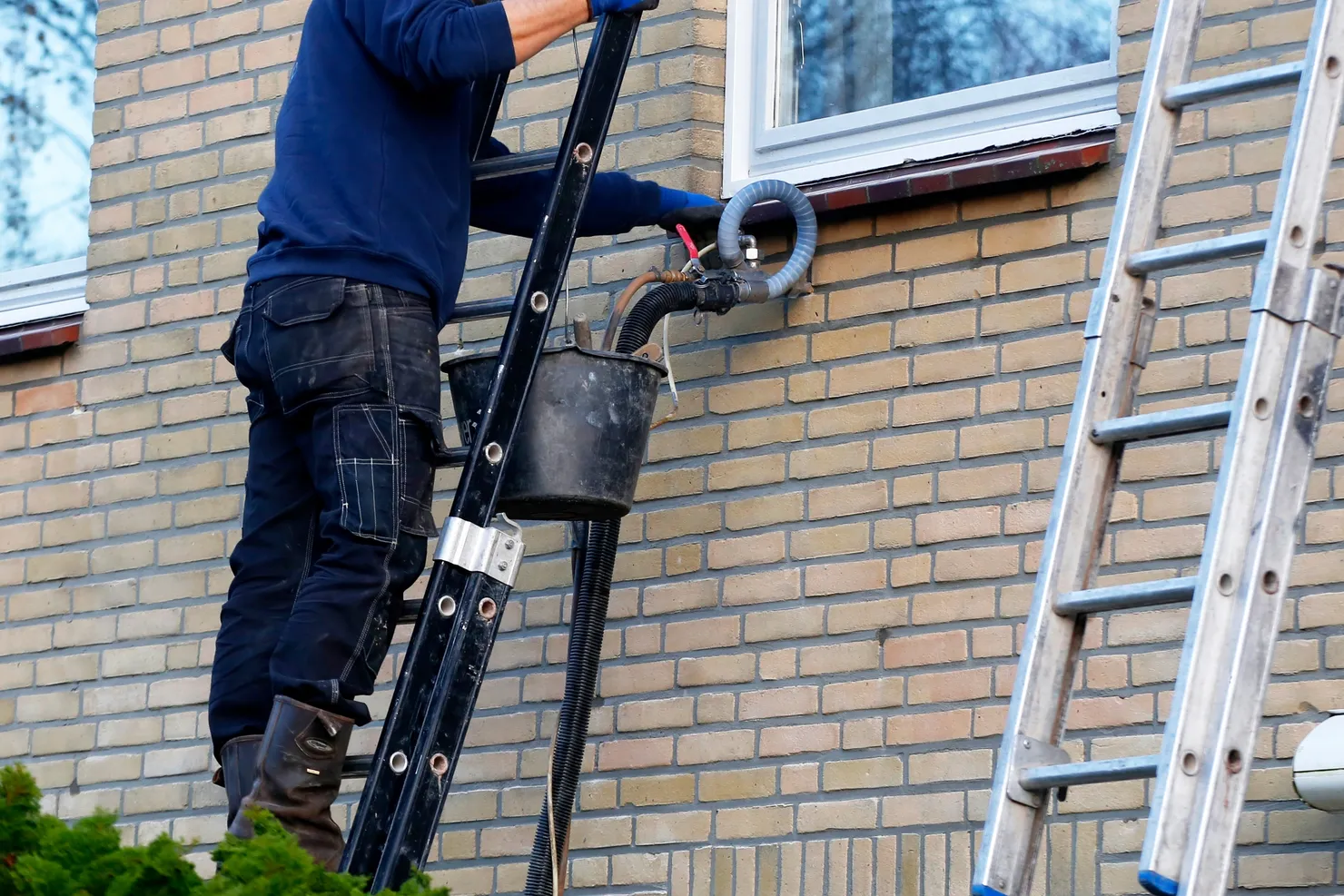
The process is unusually undramatic for something that changes a house's heat loss this much. Nobody comes inside, nothing is taken apart, and by the evening the only evidence is a grid of sealed holes you have to look for.
- 1
The hole pattern is set out
Holes of roughly 22mm are drilled into the outer leaf on a regular grid, positioned so the fill reaches every part of the cavity. The pattern follows the wall's construction rather than a fixed spacing — obstructions, openings and party walls all change it.
- 2
The cavity is filled under pressure
Material is injected through each hole in sequence, generally working upward so the cavity fills without voids. The installer reads the resistance to judge when a section is full — under-filling leaves cold spots, over-packing puts pressure on the leaves.
- 3
Holes are sealed and matched
Each hole is filled with mortar colour-matched to the existing joints. On exposed brickwork a good installer leaves work that is genuinely hard to spot; on render or pebbledash the patches often stay faintly visible, which is worth asking about beforehand.
- 4
Paperwork, which matters more than it looks
A CIGA-registered installation generates a 25-year guarantee document. Keep it with the property's papers: it is what a future buyer's surveyor asks for, and what you need if anything goes wrong years later.
Why you cannot do this yourself
The fill goes into a void you cannot see, under pressure, and is invisible the moment the holes are sealed. There is no way to inspect your own work, and the failure mode is damp in the wall rather than a wasted afternoon. Every grant scheme requires a certified installer, and the CIGA guarantee is only available through registered ones.
Suitability, and why properties get refused
A refused survey is the most misunderstood outcome in this whole measure. It is not an installer being awkward — it is the one check standing between a suitable wall and an expensive mistake.
Who qualifies
Suitable properties
- Built 1920s to 1990s (cavity construction era)
- Unfilled cavity walls confirmed by survey
- Walls in good structural condition
- No significant damp or moisture issues
- Not in a severely exposed location with persistent driving rain
Exclusions
Not suitable for
- Properties with existing damp problems
- Unusual or non-standard construction
- Some properties in conservation areas (check with your local authority)
- Very exposed coastal or hilltop locations
- Walls with damaged or blocked cavities
If cavity wall insulation is not suitable, solid wall insulation may be an alternative.
Fix first
Repairs before insulation
Several faults do not rule a property out permanently — they rule it out until repaired:
- Cracked or failed render
- Perished or missing pointing
- Defective guttering soaking a wall
- Debris left in the cavity from the original build
Exposure is a real criterion, not a formality
Walls facing sustained wind-driven rain get wet through in a way sheltered walls do not, and fill that bridges a persistently saturated outer leaf can carry moisture inward. This is why exposed coastal and hilltop properties are screened out, and why the same house design can be suitable in one location and refused in another. If your survey comes back negative on exposure grounds, that judgement is about where the house stands rather than what it is made of.
When it goes wrong
Cavity wall insulation has a poor reputation in some quarters, and the reason is worth stating plainly rather than glossing over: a proportion of installations went into properties that should never have been approved, and the resulting damp is expensive and miserable to put right. That history is why the survey is now the serious part of the job.
What failure looks like
Damp patches on internal walls, particularly on the side of the house facing prevailing weather, appearing after installation rather than before. Cold spots suggesting the fill has slumped and left a void. Mould in rooms that were dry previously.
None of these is proof on its own. CIGA's own position is that condensation or mould does not necessarily indicate a problem with the insulation — a house that is warmer and less draughty also ventilates less, and condensation has other causes. Establishing which you have is what an inspection is for.
Extraction, if it comes to it
Where insulation has genuinely failed, the remedy is extraction: removing the fill completely, usually by vacuum through the original holes or newly drilled ones. It costs more than the original installation did — it is slower, dirtier, and generates waste that has to go somewhere.
Extraction on its own also fixes nothing. The wall's underlying defect — the failed render, the exposure, the debris in the cavity — is what allowed the problem, and it needs resolving before refilling is even a question.
The CIGA guarantee, and its limits
Installations by a CIGA-registered installer carry an independent 25-year guarantee from the Cavity Insulation Guarantee Agency. Two things follow from that sentence and both matter. It applies to registered installers only, so confirm registration before the work rather than after. And the guarantee is a document with terms — CIGA does not publish the full schedule of what is covered and excluded on its website, so ask for the guarantee itself and read it.
To raise a problem: the installer first, then CIGA at concerns@ciga.co.uk or 01525 853300. Keep the paperwork with the property's documents — a future buyer's surveyor will ask for it.
Funding routes after GBIS
The Great British Insulation Scheme funded more cavity wall insulation than any other measure — it accounted for roughly a third of everything the scheme delivered. It ended on 31 March 2026, so any page still offering a GBIS eligibility check is out of date. What replaced it depends on where you live.
England
Warm Homes: Local Grant
Delivered by local authorities in England for lower-income households in private tenure, on a whole-house basis — insulation is funded as part of a package rather than as a standalone measure. Households apply through the GOV.UK Warm Homes: Local Grant service, which passes the application to their council. ECO Flex through your council is the discretionary route where standard criteria do not fit.
Warm Homes guide →Devolved nations
Scotland, Wales, Northern Ireland
Each runs its own programme and always did. Scotland has Warmer Homes Scotland, Wales has Nest, and Northern Ireland — where GBIS never applied at all — has the Affordable Warmth Scheme and NISEP.
Northern Ireland insulation grants →Which cavity wall funding route may apply to you
Grant funding for cavity wall insulation depends on where you live and your household income. GBIS closed in March 2026; the live routes are Warm Homes: Local Grant in England, Warmer Homes Scotland, Nest in Wales, and Affordable Warmth or NISEP in Northern Ireland.
Key eligibility factors:
- England only — not Wales, Scotland or Northern Ireland
- EPC band D, E, F or G
- Household income of £36,000 a year or less, a qualifying means-tested benefit, or a low-income postcode
- Owner-occupiers and private tenants with the landlord's consent (not social housing) — owner-occupiers and tenants are not expected to contribute anything, and a private landlord gets one home fully funded and pays half the cost on each additional home
- Separate caps for energy performance and low carbon heating, funding a whole-home package of measures — the caps are averaged across a council's whole project, not a sum a household can claim
- Apply on GOV.UK first and you are passed to your council, which decides — some councils have paused while their funding lasts. Greater Manchester and the West Midlands are funded through their combined authorities instead: West Midlands households still apply through the same GOV.UK service, while Greater Manchester households are sent to the GMCA retrofit portal
Check your property against the live MHCLG EPC register to see your current band and the schemes you may qualify for — free, in under a minute.
Check your propertyGet a free cavity wall survey
A professional surveyor will check whether your property is suitable for cavity wall insulation, and set out which of the live funding routes may apply where you live — the decision on any grant rests with whoever runs the scheme where you live, not with Energy Pages.
No obligation. Energy Pages connects you with certified installers in your area.
Common questions
How much does cavity wall insulation cost? ▾
According to the Energy Saving Trust, cavity wall insulation typically costs between GBP 500 and GBP 1,500 depending on property size. A mid-terrace with two exposed walls sits at the bottom of that range; a large detached house with four walls and difficult access sits at the top. Grant funding may cover it for eligible households, though the route changed in March 2026 when the Great British Insulation Scheme closed.
How do I know if my house has cavity walls? ▾
Three checks, in ascending order of reliability. Build date: properties built between the 1920s and 1990s typically have cavity walls, and post-1990 homes almost always do. Brick pattern: if every brick on the outer face is laid lengthways in a uniform pattern, the wall is likely cavity construction, whereas a repeating pattern that includes shorter brick ends indicates solid brick. Wall thickness: measure at an opening such as a window reveal or the front door — a cavity wall is usually over 260mm thick, a solid brick wall around 220mm. Your EPC report also states the wall type, and a surveyor confirms it with a borescope.
How long does cavity wall insulation take to install? ▾
Typically a few hours for a standard property, and almost always within a single day. The work is done entirely from outside, so nobody needs to move furniture or take time off beyond letting the installer reach all the external walls. Scaffolding is rarely needed — most installers work from ladders or a tower.
Can cavity wall insulation cause damp? ▾
It can, in the wrong property, which is why the survey exists. The risk is that fill bridges the cavity and gives moisture a path from the wet outer leaf to the dry inner one. That is why exposed locations facing driving rain, walls with cracked render or failed pointing, and properties with existing damp are screened out before any work is approved. In a suitable, well-maintained wall, correctly installed insulation should not cause damp — and a surveyor refusing your property is the system working rather than failing.
What is cavity wall insulation made of? ▾
Three materials are in common use. Blown mineral wool is the most widely installed and the cheapest. Polystyrene bead (EPS) flows more freely and is often preferred for narrow or partly obstructed cavities, and is bonded with adhesive so it does not slump. Polyurethane foam sets hard and is used where the wall also needs stabilising; it is the most expensive and by some distance the hardest to remove later. The survey determines which is appropriate — this is not usually a homeowner choice.
Is there a guarantee on cavity wall insulation? ▾
Installations carried out by a CIGA-registered installer carry an independent 25-year guarantee from the Cavity Insulation Guarantee Agency. The guarantee applies to registered installers only, so confirm registration before work starts rather than after. CIGA does not publish the full terms and exclusions on its website — request the guarantee document itself, and note CIGA's own position that condensation or mould does not necessarily indicate a fault with the insulation.
What happens if my cavity wall insulation fails? ▾
Raise it with the installer first, then with CIGA at concerns@ciga.co.uk or 01525 853300 if the installation was registered. Where insulation has genuinely failed or went into an unsuitable property, the remedy is extraction — removing the fill entirely, usually by vacuum through the original holes or newly drilled ones. Extraction costs more than the original installation did, because it is slower and generates waste, and the wall then needs its underlying defect fixed before refilling is even a question.
Can I get cavity wall insulation for free? ▾
Possibly, depending on where you live and your household income. The Great British Insulation Scheme, which funded most cavity wall insulation in Great Britain, closed on 31 March 2026. In England the live route is the Warm Homes: Local Grant through your local authority, with ECO Flex as a discretionary route. Scotland runs Warmer Homes Scotland, Wales runs Nest, and Northern Ireland runs the Affordable Warmth Scheme and NISEP.
Will cavity wall insulation improve my EPC rating? ▾
Usually. Uninsulated cavity walls are one of the heavier penalties in an EPC assessment, and filling them commonly moves the rating by one or two bands. The improvement only shows on your certificate once a new EPC is carried out — the existing certificate does not update itself, and the assessor needs evidence the work was done.
Can I install cavity wall insulation myself? ▾
No. The equipment injects material under pressure into a sealed void, the fill has to be distributed evenly with no gaps or over-packing, and the result is invisible once the holes are sealed — there is no way to inspect your own work. It is also the one insulation measure where getting it wrong damages the building rather than merely wasting money. Every grant scheme requires a certified installer, and the CIGA guarantee is only available through registered ones.
My cavity walls were already filled — can they be topped up? ▾
Sometimes, though it is less common than with loft insulation. A borescope inspection shows whether the existing fill has slumped, was only partly installed, or has degraded. Where a cavity was filled decades ago and the material has settled, leaving the upper portion empty, a top-up may be possible. Where the original fill is intact there is nothing useful to add — the cavity is a fixed volume.
Does cavity wall insulation work on a rendered or pebbledashed house? ▾
Yes — the construction underneath is what matters, not the finish. The practical difference is cosmetic: drill holes are sealed and colour-matched to mortar on exposed brickwork, but on rendered or pebbledashed walls a perfect match is harder and the patches may stay faintly visible. Ask the installer what the finish will look like before work starts. Cracked or failed render is a separate problem and should be repaired first, since it lets water into the wall.
Related guides
Grant scheme
Warm Homes: Local Grant
Whole-home upgrades including insulation for lower-income households in England, under two per-home cost caps of £16,600 — energy performance upgrades and low carbon heating. The caps limit what a council spends per home on average; they are not a sum a household receives.
Read guide →Closed scheme
GBIS (closed)
The scheme that funded most cavity wall insulation until March 2026, kept as a record with the live routes mapped.
Read guide →EPC guide
Improve your EPC rating
See how cavity wall insulation boosts your EPC and what other improvements to consider.
Read guide →Ready to insulate your cavity walls?
Find the funding route that is open where you live — and if none fits, cavity wall is among the cheapest measures to fund yourself.