Information notice
Panel counts are based on industry guidance and typical UK household data. Your actual requirements may differ based on specific electricity usage, panel specifications, and roof conditions. Always get a site survey from an MCS-certified installer for accurate system sizing.
Panels Needed by Household Size
| Household | Typical annual usage | System size | Panels needed | Roof space |
|---|---|---|---|---|
| 1–2 bed | 1,800–2,500 kWh | 2–3kW | 6–8 panels | Approx. 10–14m² |
| 3 bed | 2,700–4,100 kWh | 3–4kW | 10–12 panels | Approx. 17–21m² |
| 4+ bed | 4,000–5,500 kWh | 4–6kW | 12–16 panels | Approx. 21–28m² |
| 4+ bed + EV | 5,500–8,000 kWh | 5–6kW+ | 14–18+ panels | Approx. 24–32m² |
Source: based on industry guidance and Ofgem typical domestic consumption values. Panel counts assume 380-420W panels. Actual requirements depend on panel wattage, roof orientation, and individual electricity usage.
Factors That Determine How Many Panels You Need
Factor 1
Your electricity usage
The starting point is how much electricity your household uses per year. Check your energy bills or annual statement for your actual kWh consumption. According to Ofgem, the typical UK household uses approximately 2,700 kWh per year, but this varies significantly.
Higher usage households (electric heating, electric vehicle, home working) will need larger systems.
Factor 2
Panel wattage
According to manufacturers, modern residential solar panels typically range from 350W to 450W per panel. Higher wattage panels generate more electricity per panel, meaning you need fewer of them to achieve the same system size.
A 4kW system needs 10 x 400W panels, or 12 x 340W panels. Higher wattage panels cost more per unit but save roof space.
Factor 3
Roof space and layout
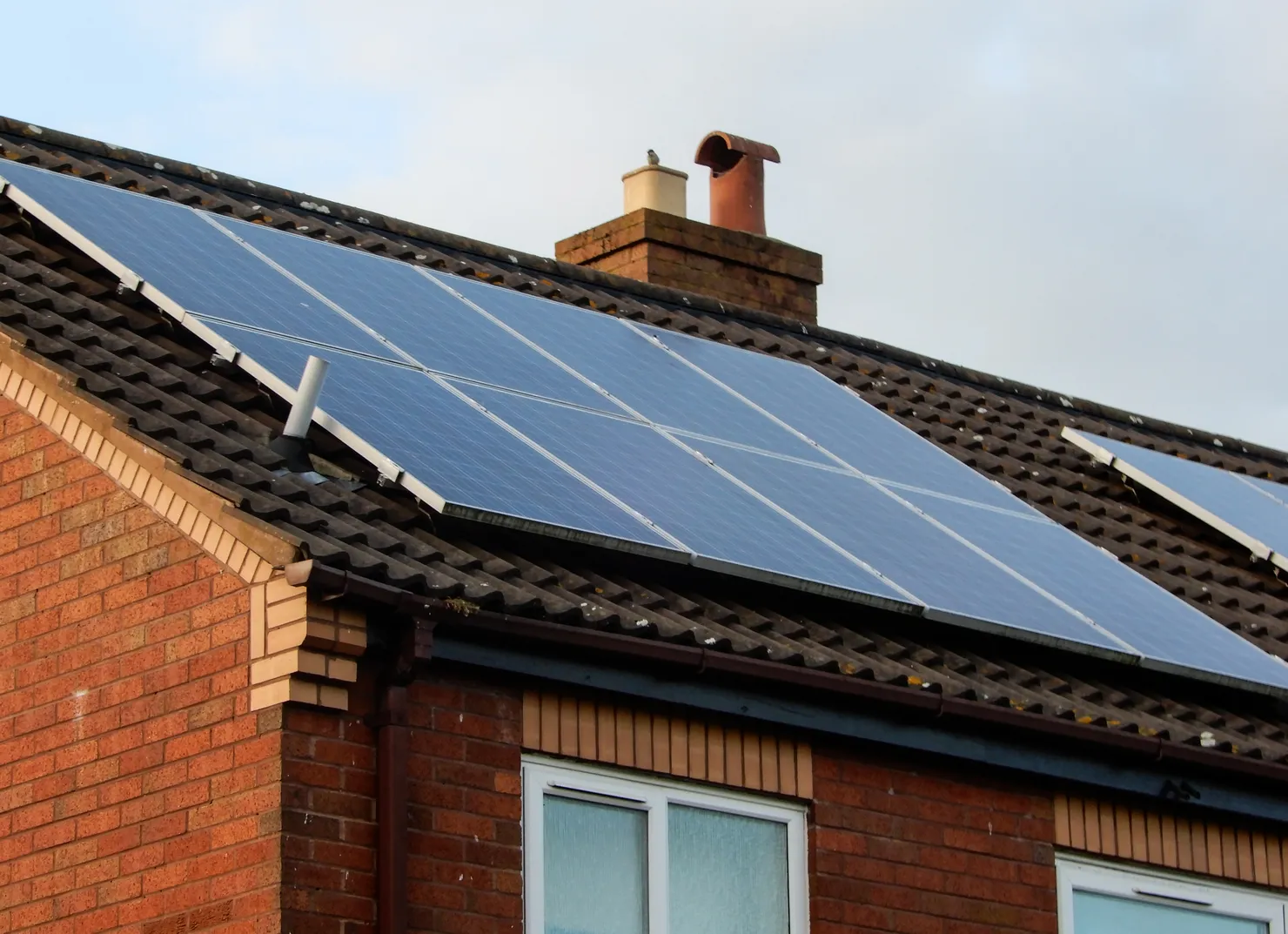
According to installer data, a standard residential solar panel measures approximately 1.7m x 1m (about 1.7 square metres). You need to account for obstructions such as chimneys, dormers, roof windows, and vents that reduce usable space.
Panels can be split across multiple roof faces, though this may require additional equipment (optimisers or microinverters).
Factor 4
Roof orientation and pitch
According to the Energy Saving Trust, roof orientation significantly affects solar panel output. South-facing roofs generate the most electricity. East or west-facing roofs generate approximately 15-20% less.
The ideal roof pitch in the UK is approximately 30-40 degrees from horizontal. Flat roofs can use angled mounting frames.
How Roof Orientation Affects Output
According to the Energy Saving Trust, roof orientation is one of the most important factors in determining how much electricity your solar panels will generate. A south-facing roof at an optimal pitch receives the most sunlight throughout the year.
If your roof faces east or west rather than south, your panels will generate less electricity, and you may need additional panels to compensate. East-facing panels generate more in the morning, west-facing panels more in the afternoon.
North-facing roofs are generally not recommended for solar panels in the UK, as they receive significantly less direct sunlight. An MCS-certified installer can assess your specific roof and provide accurate generation estimates.
Data viz
Relative output by direction
Source: based on Energy Saving Trust orientation guidance for UK installations. Actual output varies by location and pitch.
Quick Sizing Calculation
Estimate your panel count
- 1 Find your annual electricity usage from your energy bill (in kWh). If you cannot find this, use the Ofgem typical value of 2,700 kWh as a starting point.
- 2 Decide what proportion you want to cover. Most homeowners aim to cover 50-80% of their electricity usage with solar. Covering 100% is possible but means exporting a lot of surplus in summer.
- 3 Calculate the system size needed. In the UK, according to industry data, each 1kW of solar capacity generates roughly 800-1,000 kWh per year (depending on location and orientation).
- 4 Divide by panel wattage. For example, a 4kW system using 400W panels needs 10 panels. Using 350W panels, you would need about 12 panels.
Worked example
Example calculation
Check your solar panel eligibility
Some households may qualify for subsidised solar panel installation through government schemes. Check your eligibility.
Key eligibility factors:
- Open now — the installation must be completed by 31 December 2026
- England, Scotland or Wales (not Northern Ireland)
- On a qualifying benefit, in social housing rated EPC E–G, or referred through ECO4 Flex by a council that takes part
- Eligibility is not a guarantee — suppliers decide which measures they fund
Check your property against the live MHCLG EPC register to see your current band and the schemes you may qualify for — free, in under a minute.
Check your propertyGet accurate solar panel sizing
An MCS-certified installer can survey your roof, review your electricity usage, and recommend the exact number of panels for your home.
One matched certified installer. Never a list. No obligation.
Getting the right system size
Check your bills
Find your annual electricity usage in kWh from your energy bills or annual statement.
Get a site survey
An MCS-certified installer assesses your roof space, orientation, shading, and structural suitability.
Compare quotes
Get at least three quotes and compare system sizes, panel brands, and total costs.
Consider future needs
If you plan to get an electric vehicle or heat pump, consider a larger system now to accommodate future electricity demand.
Related guides
Costs
Solar panel costs
Now you know how many panels you need, see what your system will cost.
See costs →EPC
EPC ratings explained
Understand how solar panels affect your EPC rating and what each band means for your property.
Read guide →Storage
Battery storage guide
Store excess solar energy in a home battery instead of exporting it at lower SEG rates.
Read guide →Get your solar panel sizing right
MCS-certified installers provide accurate system sizing based on a professional survey of your roof and electricity usage.