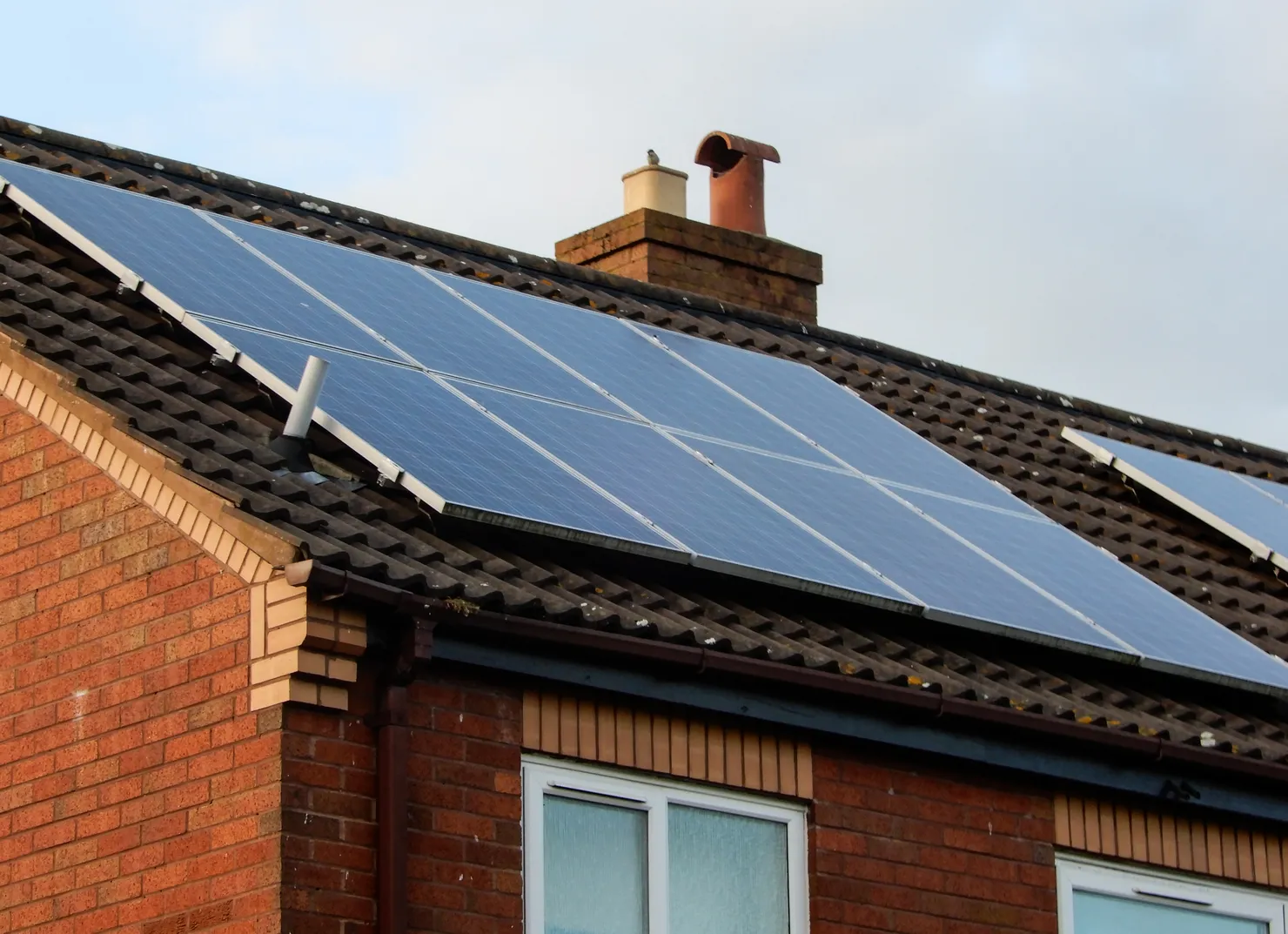
The 60-second answer
- 3 kW system: £5,000–£7,000. 4 kW: £6,000–£10,000. 5-6 kW: £8,000–£12,000. 8 kW+: £12,000–£18,000. How many panels each size means depends on wattage and roof.
- Battery adds £4,500–£10,000. 5 kWh typical, 10 kWh for high-usage homes or EV charging.
- 0% VAT until March 2027. Universal — every homeowner saves ~£1,000–£2,000 on a 4 kW install.
- Regional variance is real. London 15-25% more expensive than the North of England for the same install.
- Payback: 7-10 years on a typical 4 kW. With battery and a 15p SEG tariff like Octopus Outgoing, 5-7 years.
Independent information
Cost ranges on this page are drawn from the Energy Saving Trust (2024 published figures), ONS labour cost data, MCS installer pricing surveys, and Ofgem-published SEG tariff tables. We are not a solar installer and do not issue quotes. For accurate pricing on your roof, get three written quotes from MCS-certified installers — MCS certification is mandatory for SEG export tariff enrolment.
The 2026 solar landscape — what's changed
Solar economics in 2026 sit very differently from 2019 when most online cost guides were written. Three factors have shifted decisively in solar's favour, and one factor sets a deadline you should plan around.
Panel costs have fallen. The hardware cost of solar panels has dropped 10-15% since 2022 in real terms, despite the broader energy industry inflation. Tier-1 modules (LONGi, JA Solar, Trina, Jinko) now cost installers around £0.25-£0.35 per watt at trade prices. Premium brands (REC, SunPower, Q.CELLS) sit higher. The component cost is no longer the bottleneck.
Electricity import prices have risen. Ofgem's default tariff cap sits at 26.32p/kWh for 1 October to 31 December 2026 — significantly higher than the 14-17p that prevailed pre-2022. Higher import prices make every kWh of self-consumed solar more valuable. Self-consumed solar is effectively a return at your import tariff; export pays at your SEG rate.
SEG tariffs from leading suppliers are competitive. Octopus Outgoing pays 15p/kWh fixed on a 12-month tariff (requires Octopus as import supplier). Scottish Power SmartGen pays 12p/kWh. EDF Export+ pays 8-12p. Compare that to the residual Feed-in Tariff rates that incumbents still quote — SEG has caught up materially.
The 0% VAT cliff is real and approaching. HMRC's zero-rate on residential solar runs until at least March 2027. Beyond that, the rate reverts to either 5% (reduced rate for energy-saving materials) or 20% — the policy decision has not been confirmed. On an £8,000 install, the difference between 0% and 20% is £1,600. If you're planning to install in the next 18 months, the deadline is a genuine factor.
Cost by system size
System size is measured in kilowatt-peak (kWp). Each 1 kWp typically generates 850-1,000 kWh per year in the UK on a south-facing roof at 30-35 degree pitch with minimal shading. North-facing, shaded, or low-pitch installations underperform that range; west- or east-facing roofs typically achieve 75-90% of south-facing yield.
Small
3 kW system
~6-8 panels. Suits small 2-bed homes, low-usage households, or smaller roof areas.
Generation typically 2,550-3,000 kWh per year. Direct self-consumption around 30-40% without battery. Suits low-electricity-demand households or where roof area is limited. The cheapest entry point to solar; payback typically 8-11 years against current SEG tariffs without battery.
Most common
4 kW system
~10 panels. The UK's most common residential size. Suits typical 3-bed homes.
Generation typically 3,400-4,000 kWh per year — close to the average UK household's annual electricity use of 2,700 kWh. Direct self-consumption around 35-45% without battery; 70-80% with battery. The sweet spot for cost/payback on most UK homes. 7-10 year payback typical; 5-7 years with battery and a 15p SEG.
Larger
5-6 kW system
~12-15 panels. Suits 4-bed homes, EV charging, or high-electricity demand.
Generation typically 4,250-6,000 kWh per year. Recommended where you have an EV (4,000+ kWh of additional demand), a heat pump (3,000-5,000 kWh additional), or simply higher background usage from a larger household. Per-watt cost slightly lower than smaller systems due to fixed cost amortisation on scaffolding and labour.
High demand
8 kW+ system
~20+ panels. Larger properties, EV + heat pump combinations, off-grid-leaning installations.
Generation typically 6,800-10,000+ kWh per year. Often combined with 10+ kWh battery storage for self-sufficiency on grid-tied installations, or large battery banks for off-grid scenarios. Per-watt cost continues to scale down with size. Roof area is often the constraint — 8 kW needs around 40m² of unshaded south-facing roof.
Premium panel brands and the price ladder
Within each system size, panel brand drives 20-40% of the price spread. Tier-1 mid-range (LONGi, JA Solar, Trina, Jinko) sits at the lower end. Premium brands (REC Alpha, SunPower Maxeon, Q.CELLS Q.PEAK DUO, LG NeON — though LG exited the consumer solar market in 2022) sit at the upper end. Premium panels offer slightly higher conversion efficiency (22-23% versus 19-21%) and stronger long-term warranties (25 years at 92% of original output versus 25 years at 80-85%). The cost premium is usually 30-50%; the efficiency uplift means premium panels generate more from the same roof area, which can pay back the premium on small roofs but rarely on large ones.
What's in a proper MCS quote
Quote line items vary by installer, but a well-itemised MCS quote should cover the following. Anything bundled into a single "installation" figure is worth asking about — transparency is a good signal.
Panels and mounting
Make, model, watt rating per panel (350-450 W typical), quantity. Mounting system: brand, on-roof or in-roof, fixings. Bird mesh if relevant for the local environment.
Inverter
Make, model, rating, type (string, hybrid, micro). Hybrid inverter recommended if you're adding battery now or in the next few years. Premium brands: SolarEdge, Enphase, Fronius, GoodWe. Mid-range: Solis, Growatt.
DC and AC isolators
Mandatory safety equipment between the panels, inverter, and consumer unit. Specifies allows for isolation in fire emergencies. Should be itemised, not bundled.
Generation meter
Records solar generation output for warranty and SEG reporting. Some smart meters can serve as the generation meter; otherwise a dedicated unit (~£100–£200) installed.
Scaffolding
£300–£800 depending on access, building height, and how many roof faces need cover. Should be a separately itemised line. Some installers include it free for marketing; check what "free scaffolding" means in the small print.
Cable runs and AC connection
DC cable from panels to inverter (typically in the loft); AC cable from inverter to consumer unit. May need a new consumer unit or upgraded RCD if the existing board is at capacity. Add £200–£500 for board upgrades.
MCS certification and DNO notification
The installer registers the install with MCS (mandatory for SEG enrolment) and notifies your Distribution Network Operator (DNO). DNO approval is automatic for systems up to 3.68 kWp per phase; larger systems may need pre-approval and occasionally grid upgrade. Approval costs nothing in most cases.
Battery (if included)
Make, model, useable capacity (kWh), warranty term, depth-of-discharge spec, cycle life. AC-coupled vs DC-coupled (DC-coupled with a hybrid inverter is more efficient). Premium: Tesla Powerwall, sonnenBatterie. Mid-range: GivEnergy, Growatt, Pylontech.
Regional pricing variance
The same solar install in different regions of the UK has materially different prices. Labour rates, scaffolding costs, parking and access fees, and supply chain density all contribute. The pattern is consistent across MCS installer surveys.
| Region | 4 kW installed price | vs UK average |
|---|---|---|
| London (Zones 1-2) | £9,500-£11,500 | +20-25% |
| London (Outer) + South East | £8,500-£10,500 | +10-15% |
| South West | £7,500-£9,500 | UK average |
| East of England | £7,800-£9,800 | +2-5% |
| Midlands | £7,000-£9,000 | -5% |
| North West | £6,500-£8,500 | -10% |
| Yorkshire and Humber | £6,500-£8,500 | -10% |
| North East | £6,200-£8,200 | -15% |
| Scotland | £6,500-£8,500 | -10% |
| Wales | £6,500-£8,500 | -10% |
| Northern Ireland | £6,200-£8,200 | -15% |
Tip: if you live on the edge of a high-cost region, get quotes from installers based one ring out. A Surrey-based MCS installer working in west London is often 10-15% cheaper than a central London brand for the same install — and frequently uses the same panels and inverters. The labour-rate differential is the saving, not quality.
Battery storage — when it earns its keep
A solar-only system typically self-consumes 30-40% of generation; the remainder exports at your SEG rate. A battery shifts that ratio — self-consumption rises to 70-80%, export drops to 20-30%. Two value streams emerge: (1) you offset more import at your full import tariff rate (26.32p/kWh at the current cap) rather than exporting at your SEG rate (5-15p); (2) on time-of-use import tariffs like Octopus Cosy or Agile, you can charge the battery overnight at 7-9p/kWh and discharge at peak-evening 30p/kWh.
Battery cost ranges:
| Battery size | Mid-range price | Premium price | Suits |
|---|---|---|---|
| 5 kWh | £4,500-£5,500 | £5,500-£6,500 | Standard 3-4 kW solar, average household |
| 10 kWh | £6,500-£8,000 | £8,000-£10,000 | 4-6 kW solar, EV or heat pump household |
| 15 kWh | £9,000-£11,000 | £11,000-£14,000 | High-demand, multi-EV households |
| 20+ kWh | £12,000+ | £15,000+ | Near-off-grid or commercial use |
Battery payback math
A 5 kWh battery saving 1,500 kWh of import annually (offsetting at 26.32p/kWh) plus time-of-use arbitrage of 1,000 kWh saving £230/year nets around £625 annual benefit. At £5,000 install cost, that's ~8.0 year payback for battery alone. Modern lithium iron phosphate (LFP) batteries typically warrant 10 years at 80% capacity retention; real life often exceeds 15 years. Battery economics improve significantly on the right tariff, weaken on a flat-rate import tariff.
Lifecycle costs — what to budget over 25 years
Solar panels typically come with 25-year performance warranties. The panels themselves often last longer in real life — 30 years is common — but two components have shorter lives.
Inverter replacement. String and hybrid inverters typically last 10-15 years before replacement. Budget £500-£1,500 for a like-for-like replacement once during the panel's lifetime; £1,500-£3,000 if you're upgrading to a hybrid inverter to add battery storage. Microinverters (one small unit per panel, brand: Enphase) last longer — typically 25 years matched to panel warranty — but cost more upfront.
Battery replacement. Lithium iron phosphate (LFP) batteries typically warrant 10 years at 80% capacity retention. Real-life cycle life often exceeds 15 years. Budget for one replacement during the panel's lifetime if you install battery now.
Cleaning and maintenance. Most domestic solar installations need cleaning every 2-3 years (£80-£250) to maintain output. Annual visual inspection is free; full diagnostic service every 5 years costs £100-£200. Panels self-clean to a degree in UK rainfall; only seriously soiled or bird-droppings-affected installations need more frequent cleaning.
Total 25-year cost summary: for a 4 kW system at £8,000 install, budget around £10,000-£12,000 across the full 25-year life including one inverter replacement, occasional cleaning, and minor repairs. Against generation of ~85,000 kWh over 25 years (at 3,400 kWh/year declining gradually), that's around 12p-14p per kWh of solar electricity over the full life — significantly below grid import prices.
Real payback math — three scenarios
Payback depends on system cost, self-consumption ratio, import tariff, and SEG tariff. Three realistic scenarios for a 4 kW system generating 3,400 kWh/year against the Ofgem cap for 1 October to 31 December 2026 (26.32p/kWh import) and current SEG offerings. All figures assume electricity prices held steady; real returns improve if grid electricity prices rise.
Baseline
Solar only, no battery, 5p SEG
4 kW install £8,000. 40% self-consumption (1,360 kWh × 26.32p = £358). 60% export (2,040 kWh × 5p = £102). Total: £460/year.
Better tariff
Solar only, 15p SEG (Octopus Outgoing)
4 kW install £8,000. 40% self-consumption (1,360 kWh × 26.32p = £358). 60% export (2,040 kWh × 15p = £306). Total: £664/year.
Best return
Solar + 5 kWh battery, 15p SEG, TOU arbitrage
4 kW + 5 kWh battery £13,000. 75% self-consumption (2,550 kWh × 26.32p = £671). 25% export (850 kWh × 15p = £127). TOU arbitrage £230. Total: £1,028/year.
What shortens the math materially
- South-facing roof at 30-35° pitch with minimal shading
- High-electricity-demand household (EV charging, electric heating, working from home)
- A premium SEG tariff (Octopus Outgoing 15p or Octopus Agile Outgoing variable, which can exceed 25p at peak)
- Time-of-use import tariff paired with battery (Octopus Cosy, Octopus Go, Agile)
- Self-installing a smaller system (uncommon but possible — though MCS install is required for SEG enrolment)
- Rising electricity prices (every 1p/kWh rise on import shortens payback ~0.3 years on a typical install)
Finance options
Installer finance
0% installer finance — sometimes genuine
Some MCS installers offer 0% interest finance over 12-36 months. The test is identical to boiler finance: ask for the cash price and the finance price separately. If they match, the 0% is genuine. If the finance price is higher, you're paying interest packaged as a price markup. Compare total cost over the term divided by months.
Green loans
Green Deal loan and successor schemes
The original Green Deal closed in 2015 but several lenders offer "green home improvement" loans at preferential rates (typically 5-8% APR over 5-10 years). Lloyds, Halifax, NatWest, and the Co-operative Bank publish green loan products. Worth comparing against personal loan rates; the headline "green" framing doesn't always translate into the best deal.
Personal loan
High-street personal loan
A standard personal loan from a high-street bank at 6-12% APR over 3-5 years is often cheaper than installer finance once any markup is factored in. £8,000 over 4 years at 8% APR = £195/month, total £9,360. Shop the cash price first, then arrange finance separately for negotiating leverage.
Subscription
Solar subscription / pay-as-you-generate
A handful of providers (Sunsave, Solarsense, Beam) offer solar-on-subscription models where you pay a fixed monthly fee covering install, maintenance, and ownership transfers after typically 15-25 years. Useful where upfront capital is the blocker. Total cost over the term is typically 30-60% more than ownership; trade-off is zero upfront, no maintenance worry, and predictable monthly cost.
Grants & VAT
Grants and 0% VAT
Not finance per se, but materially reduces the upfront cost. 0% VAT is universal until March 2027 — automatic discount of around £1,000–£2,000 on a typical install. Warm Homes: Local Grant, in England only, can fund solar as part of whole-home retrofit packages for qualifying households.
Check your grant eligibility
Warm Homes: Local Grant is England only, and runs to 31 March 2028. You may qualify if your home has an EPC of D, E, F or G and your household income is £36,000 a year or less — or, above that threshold, if someone in the household receives certain means-tested benefits or your postcode is on the scheme's low-income list. Apply through the GOV.UK service, which passes you to your council; the council arranges and pays for the work, so whether anything happens depends on it still having funding. Owner-occupiers are not asked to contribute, so where the grant lands, the cost analysis above becomes academic. In Scotland, Wales and Northern Ireland, different schemes apply.
Warm Homes: Local Grant eligibility check (England)
Check your EPC band against the live register — the first test for Warm Homes: Local Grant, alongside the income, benefits or postcode route.
Key eligibility factors:
- England only — not Wales, Scotland or Northern Ireland
- EPC band D, E, F or G
- Household income of £36,000 a year or less, a qualifying means-tested benefit, or a low-income postcode
- Owner-occupiers and private tenants with the landlord's consent (not social housing) — owner-occupiers and tenants are not expected to contribute anything, and a private landlord gets one home fully funded and pays half the cost on each additional home
- Separate caps for energy performance and low carbon heating, funding a whole-home package of measures — the caps are averaged across a council's whole project, not a sum a household can claim
- Apply on GOV.UK first and you are passed to your council, which decides — some councils have paused while their funding lasts. Greater Manchester and the West Midlands are funded through their combined authorities instead: West Midlands households still apply through the same GOV.UK service, while Greater Manchester households are sent to the GMCA retrofit portal
Check your property against the live MHCLG EPC register to see your current band and the schemes you may qualify for — free, in under a minute.
Check your propertyLooking for an installer? The Energy Pages installer directory lists solar PV and battery installers by county.
Affiliate link — Energy Pages may earn a commission if you buy through it, at no extra cost to you.
Get solar installation quotes
Share your postcode and roof orientation. Energy Pages will route you to MCS-certified solar installers in your area for accurate quotes. Single-enquiry routing — your details go to one matched installer, not a list of cold callers.
No multi-broker lead sales. Your details go to one matched MCS installer.
Frequently asked questions
How much do solar panels cost in the UK in 2026?
3 kW system £5,000–£7,000 installed, 4 kW £6,000–£10,000, 5-6 kW £8,000–£12,000, 8 kW+ £12,000–£18,000. Battery storage adds £4,500–£10,000. 0% VAT applies until at least March 2027.
What is the typical payback period?
For a typical 4 kW system on a south-facing roof with 50% self-consumption and a 5p/kWh SEG export tariff, payback runs 7-10 years against current import electricity prices. With battery and a 15p/kWh SEG tariff like Octopus Outgoing, payback can shorten to 5-7 years.
What is the 0% VAT rate?
HMRC zero-rates residential solar installations until at least March 2027. On a typical 4 kW system costing £8,000 before VAT, the saving is £1,600 compared to the 20% standard rate.
What size system do I need?
For an average UK 3-bed home using 2,700 kWh/year, 3-4 kW typically covers 75-100% of annual electricity with battery, or 30-40% direct self-consumption without. Higher-usage homes (EV, heat pump, electric heating) need 5-8 kW.
How much does battery storage add?
5 kWh battery £4,500-£6,000, 10 kWh £6,000-£10,000. Premium brands (Tesla Powerwall, sonnenBatterie) sit at the top of each range. Battery improves self-consumption from 30-40% to 70-80% and enables time-of-use arbitrage worth £150-£400/year on the right tariff.
Do prices vary by region?
Yes. London and South East 15-25% more than North England, Wales, Scotland. Same 4 kW system: ~£8,000 in Newcastle vs £10,500 in central London. Edge-of-region installers often beat city-centre rates 10-15%.
How long do solar panels last?
25-year performance warranty typical (80-85% of original output). Real-world life often exceeds 30 years. Inverter is the shorter-life component: 10-15 years, replacement £500-£1,500. Battery: 10-year warranty, often 15+ years in real life.
Do I need scaffolding?
Yes for most roof-mounted installs. £300-£800 depending on access. Reputable installers include it in the quote — check the line item before signing. Bungalows and flat-roof installs can sometimes use cherry-pickers more cheaply.
String vs hybrid inverter?
String converts DC to AC for solar-only systems. Hybrid does the same plus integrates battery on the DC side (more efficient). Paying £200-£600 more for a hybrid inverter now beats retrofitting later if battery is in your roadmap.
Is solar still worth it in 2026?
On the right roof with the right tariff, yes. Panel costs down 10-15% since 2022, import electricity prices up materially, SEG export from leading suppliers reaches 15p/kWh. 0% VAT until March 2027. Payback 7-10 years typical; 5-7 with battery and a 15p SEG.
What 0% finance options exist?
Some MCS installers offer 0% over 12-36 months. Test it: ask for cash price and finance price separately. If they match, genuine. If finance price is higher, you're paying packaged interest. Personal loans (6-12% APR) often beat installer finance once markup is factored in.
Solar costs vs solar grants — which page?
This page covers out-of-pocket costs. Solar grants (WH:LG in England, ECO Flex, 0% VAT, SEG) are covered on the dedicated solar grants guide. SEG is ongoing income from exported electricity, not an upfront grant — covered in both pages because it changes payback math materially.
Related guides
Installers
The best solar installers in the UK
National firms ranked on their Trustpilot score, each checked on the MCS register and at Companies House. The method is published and no firm pays for a place.
See the ranking →Grants
Solar panel grants
Every grant route for solar — 0% VAT, WH:LG (England), ECO Flex, SEG. The funding map alongside the cost picture.
Read grants guide →Export tariff
Smart Export Guarantee
Current SEG tariffs in detail — fixed vs variable, which suppliers, how to apply.
SEG guide →Storage
Solar battery storage
Battery sizing, brand comparison, when battery improves payback and when it doesn't.
Battery guide →England only
Warm Homes Plan
Whole-home retrofit through Warm Homes: Local Grant, England only. Its two £16,600 figures are per-home cost caps averaged across a council's project, not cash a household receives. Includes solar for qualifying households.
WHP guide →Heat pumps
Heat pump costs
Solar pairs well with a heat pump — increases self-consumption and reduces grid import. Heat pump pricing in detail.
Heat pump guide →Calculator
Solar sizing calculator
Postcode + roof orientation + roof area — kWp recommendation, generation estimate, payback period.
Use calculator →Get your solar installation quotes
MCS-certified installers can model your roof, propose system size, and quote accurately for your circumstances. The 0% VAT cliff is real — plan around March 2027.